Children
Fever and newborn babies

Fever and newborn babies. A fever, also known as pyrexia, is a transient rise in body temperature that typically occurs beyond €100.4^{\circ}F\) (\(38^{\circ}C\)), serving as an immunological reaction to bacterial or viral diseases. The body uses it as a defense mechanism to combat sickness. Sweating, headaches, chills, and shivering are typical symptoms.
FEVER AND NEWBORN BABIES
Infants in their first four weeks of life are known as newborns, or neonates. They are distinguished by quick changes, frequent sleeping (14–17 hours a day), and frequent feedings (every two to four hours). Skin-to-skin contact, drying the umbilical cord, postponing washing, and feeding on demand are examples of essential care. Their primary mode of communication is crying, which peaks around four weeks.
What Is An Infant Fever?
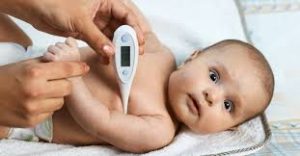

A fever is defined as a temperature of 100.4 degree Fahrenheit or greater in new borns and babies. Infants often have a temperature between 97.3 and 100.3 degrees Fahrenheit. Your baby gets a fever to ward off infections
When a baby has afever, they typically feel warmer and look flushed. Fever frequently causes perspiration, shivering, bodily aches, loss of appetite, and irritability. In the event that your infant develops a fever, please call your doctor immediately
Symptoms;
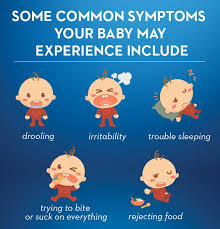

If your infant has a high temperature, there will probably be noticeable symptoms. Frequently, your infant will behave and react differently than typical to routine tasks like feeding, sleeping, and playing. Your baby’s feveris indicated by the following signs of newborn fever:
- Seizures
- Fewer wet diapers
- Rash
- Vomiting
- Diarrhea
- Looks ill
- Sore throat
- Ear infection
- Body aches
- Headaches
Causes;
What gives newborns a fever? Fever in babies and infants is mostly caused by three factors: dehydration, hyperthermia, and infections. These “fever in baby” reasons each have distinct qualities of their own:
Infection;
Generally speaking, a fever indicates that your baby’s immune system is active and battling an infection. A fever is present in almost half of infants who are infected
Overheating

FEVER AND NEWBORN BABIES
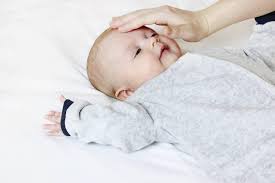
When a baby is close to a heater or is covered in multiple layers of clothing and blankets, they can easily and rapidly become overheated. This might happen in a warm automobile or at home.
Dehydration
When a baby is close to a heater or is covered in multiple layers of clothing and blankets, they can easily and rapidly become overheated.This might happen in a warm automobile or at home.
How Do I Take My Baby’s Temperature?
Taking your baby’s temperature in their ear or beneath their arms is called axillary. Mercury thermometers should be avoided as they have the potential to break and cause mercury exposure or poisoning.
Treatment;

FEVER AND NEWBORN BABIES
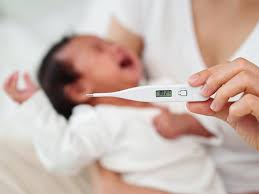
Whenever your baby has a fever, contact your infant’s primary care physician. It’s not always necessary to take your infant to the hospital. If your child doesn’t require medical attention, there are a number of methods you can care for them at home:
1. Put on thin or light garments for your infant.
2. Assist your infant in drinking enough water
3. Take a lukewarm bath for your infant. Never bathe a baby in cold water if they have a temperature. They might shiver, have chills, or even feel hotter as a result of this. Bathe your infant with sponges.
4. To chill your baby, turn on a low-powered fan that is soft.
Summary
A rectal temperature of 100.4°F (“38^{\circ}C”) or greater in a baby (less than three months old) is considered a medical emergency. Babies’ immune systems are still developing, therefore Serious illnesses like meningitis or sepsis can develop rapidly from infections. If you have a fever at this age, call your pediatrician or visit the ER right away.