Diseases
Risk Factors of Parkinson’s Disease

Risk Factors of Parkinson’s Disease. Scientists are now investigating novel therapies and possible cures for Parkinson’s disease. Understanding the disease’s fundamental causes, enhancing early detection, and creating treatments that can halt or delay the disease’s progression are the main goals of current research. Future treatments may be more successful thanks to developments in gene therapy, neuroprotective therapies, and regenerative medicine.
RISK FACTORS OF PARKINSON’S DISEASES
Although the precise origin of Parkinson’s disease is unknown, a mix of environmental and hereditary factors are thought to be responsible. Ten to fifteen percent of instances are associated with genetic changes, while the majority are sporadic, meaning there is no obvious family history. environmental elements, including exposure to heavy metals, pesticides, and herbicides. have also been linked to a higher chance of Parkinson’s disease.
Risk Factors;
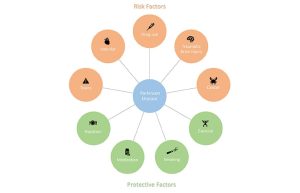

Age is the most significant risk factor, with most people being diagnosed after the age of 60. Men are more likely to develop Parkinson’s than women, and a family history of the disease can further increase the risk.
Symptoms and Progression;
Parkinson’s disease primarily affects movement, but it can also cause a variety of non-motor symptoms. The most common motor symptoms include:
– Tremor: A rhythmic shaking, usually starting in the hands or fingers, even at rest.
– Bradykinesia: Slowness of movement, making routine tasks take longer and affecting fine motor skills.


– Rigidity: Stiffness in the limbs and trunk, often leading to muscle pain or discomfort.
– Postural Instability: Impaired balance and coordination, increasing the risk of falls.
Non-motor symptoms can include depression, anxiety, cognitive impairment, sleep disturbances, and autonomic dysfunction (e.g., problems with blood pressure regulation and bowel function). The progression of Parkinson’s disease varies widely among individuals. While the disease is not fatal, it can significantly impact quality of life over time.
Diagnosis and Treatment;


Risk Factors of Parkinson’s Disease
There is no definitive test for Parkinson’s disease, so diagnosis is typically based on a patient’s medical history, symptoms, and a neurological examination. Imaging tests like MRI or PET scans may be used to rule out other conditions with similar symptoms.
Although there is no cure for Parkinson’s disease, several treatments are available to manage symptoms and improve quality of life. The most common treatment is levodopa, a medication that the brain converts into dopamine. Levodopa is often combined with carbidopa to enhance its effectiveness and reduce side effects. Other medications, such as dopamine agonists, MAO-B inhibitors, and anticholinergics, can also help manage symptoms.
For some individuals, deep brain stimulation (DBS), a surgical procedure that involves implanting electrodes in specific areas of the brain, may be an option. DBS can help reduce motor symptoms and allow for lower medication doses.
Living with Parkinson’s Disease;


Risk Factors of Parkinson’s Disease
Living with Parkinson’s disease involves managing symptoms and maintaining as much independence as possible. Regular exercise, physical therapy, and occupational therapy can help improve mobility, flexibility, and balance. Speech therapy can also assist with speech and swallowing difficulties that may arise as the disease progresses.
Emotional support from family, friends, and support groups is essential in coping with the psychological and social challenges of living with Parkinson’s. Developing a strong support network can help individuals maintain a positive outlook and improve their overall quality of life.
Summary
Parkinson’s disease is a neurological condition that mostly affects movement and progresses over time. It happens when dopamine-producing nerve cells in the substantia nigra, a region of the brain, start to degenerate. One important neurotransmitter that aids in controlling movement and coordination is dopamine. Dopamine levels drop when these cells deteriorate, causing Parkinson’s disease symptoms.