Spirogyra
Spirogyra



Spirogyra. Researchers are also interested in Spirogyra because of its distinct reproductive strategies and arrangement of chloroplasts. Research on spirogyras advances our knowledge of photosynthesis, algal biology, and the evolutionary links between various algal taxa. Spirogyras is an intriguing genus of green algae with ecological significance. It is a topic of scientific curiosity and environmental significance due to its unique spiral chloroplasts, function in aquatic habitats, and reproductive techniques.
SPIROGYRA
Water silk, mermaid’s tresses, and blanket weed are some of the common names for Spirogyra, a genus of filamentous charophyte green algae belonging to the order Zygnematales. The genus gets its name from the helical or spiral structure of its chloroplasts. More than 500 species of Spirogyra are often found in freshwater environments. Spirogyra can extend to many centimeters in length and measure between 10 and 150 micrometers in width (but typically not more than 60).
What is Spirogyra?


SPIROGYRA
Spirogyra belongs to the division Chlorophyta, which includes green algae. It is characterized by its filamentous structure, where cells are arranged in long, unbranched chains. The most notable feature of spirogyra is its spiral arrangement of chloroplasts within each cell. These chloroplasts are arranged in a helical pattern, giving the algae its characteristic appearance.
Habitat and Distribution;
It thrives in various freshwater habitats, including ponds, lakes, and slow-moving streams. It prefers nutrient-rich waters, often flourishing in environments with high levels of organic matter. During warmer months, spirogyra can form dense mats on the water’s surface, which may be visible as greenish or greenish-brown layers.
Structure and Reproduction;

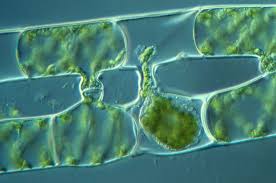
SPIROGYRA
1. Structure: Each filament of it is composed of a single row of cells, with each cell containing spiral-shaped chloroplasts. The cells have a cylindrical shape and are surrounded by a cell wall made of cellulose.
2. Reproduction: It reproduces both sexually and asexually.
– Asexual Reproduction: This occurs through fragmentation, where a filament breaks into smaller pieces, each of which can grow into a new filament.
– Sexual Reproduction: Involves the process of conjugation, where two filaments align side by side and form conjugation tubes. The contents of one filament transfer to the other, leading to the formation of a diploid zygote that can develop into a new filament.
Ecological Significance;

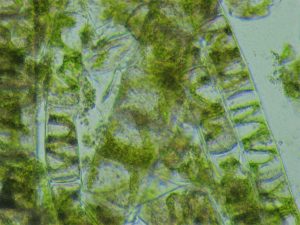
SPIROGYRA
It plays a crucial role in aquatic ecosystems by contributing to primary production. It performs photosynthesis, converting sunlight into energy and producing oxygen, which supports aquatic life. Additionally, spirogyras serves as a food source for various microorganisms and small aquatic animals.
However, excessive growth of spirogyras, often due to high nutrient levels in water bodies, can lead to algal blooms. These blooms can deplete oxygen levels in the water, causing problems for fish and other aquatic organisms.
Summary
It is well-known for both its function in aquatic environments and its characteristic spiral-shaped chloroplasts. Spirogyra, which is frequently found in freshwater settings, is crucial to aquatic ecosystems and provides information about the varied world of algae.