teaching
Benefits of Teaching Career


Benefits of teaching career. One major benefit is that teachers frequently have flexible work schedules. They often work during school hours, but they also take breaks for planning or lunch. They also receive summers and holidays off. Teachers are better able to manage their personal and professional life thanks to this flexibility. They can take care of personal matters, engage in hobbies, and spend more time with their loved ones.
BENEFITS OF TEACHING CAREER
Teachers benefit from this equilibrium because it makes them happier and less stressed. Teachers perform better, are more patient, and are more creative with their kids when they are content and not under a lot of stress. Thus, both teachers and their pupils benefit from this flexibility.
1. Opportunities for Travel

The chance to travel is another advantage of a teaching job. For unique school projects, teachers frequently get to travel with their students to historical places, museums, or even other countries. Additionally, teachers have time off during the summer and holidays to travel alone or with family. Some educators even decide to teach English or other topics in foreign nations. They can meet individuals from all over the world, experience different cultures, and pick up new languages as a result. Therefore, teaching might be a great way to travel and experience new things.
2. Financial Gains
A teaching job might result in a steady financial future because of its excellent compensation. Over time, teachers’ pay can increase, particularly as they acquire more education and experience. For example, obtaining a master’s degree in education can result in a weekly compensation of up to $1,661. Good benefits, like as health insurance, retirement plans, and occasionally even discounts on purchases, are also provided to teachers in many places. Additionally, teachers might conduct after-school groups or coach sports to supplement their income. Teachers can feel confident about their finances thanks to all of these financial benefits. Without having to worry too much about money, they may concentrate on instructing and assisting pupils.
3. Personal and Emotional Satisfaction

Because you truly impact children’s lives, teaching is fulfilling. Developing strong bonds with students while assisting and observing their intellectual and self-assurance growth is a wonderful feeling. Witnessing a student finally “get it” or conquer a problem brings a unique sense of satisfaction. These instances make all the effort worthwhile by serving as a reminder that teachers are engaged in something significant and worthwhile.
4. Stability and Job Security
It is well recognized that teaching is a steady career. Because there are always children who need to learn, instructors typically have stable occupations. In order to assist children learn new things and develop into intelligent adults, schools everywhere need qualified teachers. As a result, teachers frequently don’t have to worry about finding employment. You can almost always find a job if you’re an excellent instructor. One of the main benefits of choosing a teaching career is the job security it offers. Teachers feel more at ease knowing they have a dependable work that has an impact.
5. Influence and Input

Because they help children thrive in school and in life, teachers have a significant impact on communities. Teachers find great satisfaction in witnessing a pupil grasp a concept or conquer a difficulty. Knowing that they have contributed to someone being stronger and wiser makes them feel wonderful.
Summary
Teaching is a job full of opportunity to grow, make a difference, and balance work with fun and family time. Teachers help build the future, have flexible schedules, travel, love creative work, never stop learning, are well compensated, and feel a sense of accomplishment when they assist pupils. They also save money on daycare by enjoying their summers off.


Tips for teaching children. In order to properly teach children, play, curiosity, and positive reinforcement must be incorporated into everyday life. Reading aloud together, modeling desired behaviors, employing multisensory techniques, and encouraging independence are important tactics. Patience, clear communication, and the creation of a stimulating, encouraging environment that honors their innate curiosity are all necessary for effective instruction.
TIPS FOR TEACHING CHILDREN
For children to learn and grow, comprehension is essential. Strong comprehension abilities aid in understanding new ideas and helping them remember information, whether they are reading a book, listening to a class, or following directions. The following are some practical methods for enhancing kids’ comprehension and understanding:
1. Encourage Active Reading;

Teach kids to engage with the material by asking questions as they read and predicting what might happen next. This keeps their minds active and helps reinforce understanding.
2. Build Vocabulary
A strong vocabulary can make it easier for kids to understand what they read and hear. Introduce new words regularly and use them in conversations. Playing word games and reading a variety of books together can also expand their vocabulary.
3. Use Visual Aids;

Pictures, diagrams, and charts can make complex information more digestible. Encourage kids to draw or use graphic organizers like mind maps to represent what they’re learning visually.
4. Practice Summarizing;
After reading or listening to a story, ask kids to summarize it in their own words. This exercise helps reinforce their understanding and shows them how to pick out key details.
5. Relate to Real-Life Experiences;

TIPS FOR TEACHING CHILDREN
Connecting new information to real-life situations or their own experiences helps make abstract concepts more tangible and easier to understand.
6. Encourage Note-Taking;
Teach kids to jot down key points, ideas, or new vocabulary as they learn. Reviewing these notes later can help them remember and make sense of what they’ve learned.
7. Break Down Information;

When faced with large amounts of information, help kids break it down into smaller, manageable chunks. Studying or discussing smaller sections at a time can make learning less overwhelming.
8. Promote Asking Questions;

TIPS FOR TEACHING CHILDREN
Encourage kids to ask questions when they don’t understand something. Asking questions fosters curiosity and ensures they are actively engaging with the material.
9. Read Aloud Together;
Reading aloud, either by the child or a parent, can enhance comprehension by allowing kids to hear words and understand their context. It also gives parents an opportunity to pause and discuss what’s happening in the text.
10. Practice Patience and Consistency;

TIPS FOR TEACHING CHILDREN
Improving comprehension takes time and consistent practice. Celebrate small successes and encourage kids to keep trying, even when they find something difficult.
Summary
Enhancing children’s cognitive abilities lays a solid basis for learning throughout their lives. By employing these techniques, parents and teachers can establish a stimulating and encouraging learning environment that facilitates children’s comprehension of new material.

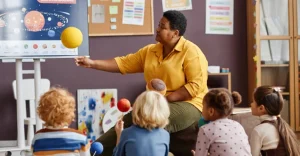
Importance of teaching with visuals. Using visual aids like charts, films, and pictures in the classroom is essential for raising student interest, enhancing knowledge retention by up to 65%, and speeding up the understanding of difficult or abstract ideas. When compared to text-only education, visual aids dramatically improve test scores because they support a variety of learning styles, encourage critical thinking, and make sessions more participatory.
IMPORTANCE OF TEACHING WITH VISUALS
By turning difficult, abstract ideas into tangible, understandable, and memorable knowledge, visual aids improve student engagement, comprehension, and retention. Charts, diagrams, infographics, movies, and graphic organizers are examples of effective visual aids that promote critical thinking, encourage curiosity, and accommodate a variety of learning preferences.

1. Foster a feeling of community Children feel unique in the daycare setting when they discover their picture. They will experience a sense of inclusion and belonging when they see themselves alongside their friends and caretakers. Create a continuous scrapbook or picture journal for the kids (individually or collectively.
2. Aids education Sometimes we wish we could just freeze the moments we spend with kids. These times are frequently used as teaching and learning opportunities.

3. Assist kids in going over Whether it’s a field trip, a new discovery or a special guest, photographs allow you to relive significant events and experiences. Look for chances to put these pictures on display or keep them nearby for the kids to view.
Importance of pictures in teaching;
4. Support language: When photographs are shown with labels or documentation, kids will learn to connect them to written print. A lot of kids who aren’t able to talk yet can express themselves through pictures.
IMPORTANCE OF TEACHING WITH VISUALS
5. Images communicate ideas more quickly. Our brains can only digest so much information in a given period of time, and the information that is most visually appealing is also the data that is processed the quickest. Given this, text blocks are not nearly as effective as images as content
6. It lessens cognitive overload. An eLearning course that offers a lot of material may overwhelm students. Keeping this in mind, effective use of visuals helps lessen cognitive overload.

IMPORTANCE OF TEACHING WITH VISUALS
7. Meanwhile, Pictures help you remember things for longer. To guarantee that knowledge is retained in long-term memory, visual aids are the simplest and most efficient method.
8. Also, It stirs up feelings Images elicit a greater and quicker response than words. These emotional responses influence how well knowledge is retained, and they facilitate user interaction with the content.
Summary
There are several reasons why you should use photographs in your work with young children. First, magic! Every adult has seen firsthand the magic that occurs when a child sees a photograph of themself. Photographs can also be used as a technique to enhance visual representations and learning.


Teachers and their important roles. A teacher’s responsibility now includes more than the centuries-old strategy of expecting students to follow their example. These days, teachers are expected to offer their students rich, unique, and personalized learning experiences. Traditional classroom environments are no longer the only places for education. It takes place in the actual and virtual worlds, at home, and in the community. These days, information is not limited to books and conventional educational resources; it can be discovered everywhere.
TEACHERS AND THEIR IMPORTANT ROLES
Despite obstacles like teacher shortages and disparate circumstances around the world, teachers are vital educators who mentor, facilitate, and inspire lifelong learning and responsible citizenship in a variety of settings, from elementary schools to universities. They guide students, impart knowledge, foster critical thinking, and shape personal growth. They play a variety of functions, adjusting to various age groups and subjects, and are crucial to the advancement of society and future prosperity.
Basic roles:
1. Giving guidance;

A safe and driven student is directly correlated with an understanding and skilled teacher. Students must understand that teachers are concerned about their learning styles and the factors that support or impede the learning process. Educators must acquire knowledge about the distinctive attributes of each student, encompassing their social, economic, and cultural upbringing.
2. Motivation of students;

Teachers and their important roles
To support students’ learning, teachers should be ready to step in at any time. Teachers should be creative educators who inspire a love of learning in their students, rather than just being experts in a certain area, like science, language, or arithmetic. To accomplish this, educators should be able to make use of various teaching strategies that cater to the aptitudes and learning styles of their pupils. They ought to, for instance, motivate students to participate actively in their studies.
3. Developing students’ healthy curiosity;

Teachers and their important roles
The most skilled educators are adept at encouraging their pupils’ natural curiosity. Candidates who develop engaging lesson plans with a variety of activities to accommodate various learning styles should be your first choice. In the process of teaching, teachers ought to see themselves as co-learners, facilitators, and guides.
4. Developing educational opportunities;
If students have some influence over the structure and subject matter of their education, they will work more cooperatively. Instructors can help students design lesson plans that will help them reach their objectives. Additionally, they can assist students in choosing.
5. Intermediary and liaison;

Teachers and their important roles
Educators frequently have to communicate with and act as a mediators between different stakeholders in the educational system. As an illustration, kids might ask teachers to assist them in communicating important information to their parents, or vice versa. teaching by asking the right questions
Summary
Teachers are important individuals who serve as mentors, facilitators, counselors, and role models. They help students develop critical thinking, creativity, character, and life skills outside of the classroom. By inspiring dreams, nurturing potential, and cultivating a love of lifelong learning, teachers essentially shape students into productive, well-rounded individuals and future contributors to society.

Music Recording Apps for Phones

Review of Bandlab Music App

N-Track Studio Review

A Step-by-Step Guide to Deleting Reels on Instagram

A Comprehensive Guide to Setting Up a YouTube Premiere








Pingback: solo adventures