communication
Body Language: Understanding Nonverbal Communication


Body language is a powerful form of nonverbal communication that reveals emotions, intentions, and attitudes. From facial expressions to posture and gestures, your body speaks volumes, often conveying more than your words. Mastering body language can improve relationships, enhance communication, and boost personal and professional interactions.
Why Body Languages Matters
1. Enhances Communication
Studies show that up to 55% of communication is nonverbal. Understanding body language helps you interpret what others feel or think, even when they don’t say it explicitly.
2. Builds Trust
Positive body languages, like maintaining eye contact and open gestures, fosters trust and connection, whether in a personal or professional setting.
3. Reveals Emotions
Body languages often reflects emotions more accurately than words. Subtle cues like crossed arms, fidgeting, or a tilted head can provide deeper insight into someone’s feelings.
4. Influences Perception
Your body languages affects how others perceive you. Confident posture and gestures can make you appear approachable, competent, and trustworthy.
Key Elements of Body Language
1. Facial Expressions

– Smiling indicates warmth and friendliness.
– Furrowed brows can signal confusion or concern.
– Eye contact shows attentiveness but can be intimidating if excessive.
2. Posture

– An upright posture conveys confidence and self-assurance.
– Slouching suggests disinterest or insecurity.
– Leaning slightly forward signals interest and engagement.
3. Gestures

– Open-handed gestures suggest honesty and openness.
– Pointing may come across as aggressive or commanding.
– Nodding encourages conversation and shows agreement.
4. Personal Space
– Respecting personal space builds comfort and trust.
– Standing too close may feel invasive, while too much distance can seem disengaged.
5. Movement
– Purposeful movements, such as hand gestures while speaking, can emphasize points.
– Fidgeting may indicate nervousness or impatience.
How to Use Body Language Effectively
1. Be Aware of Your Body Languages
Pay attention to how you stand, move, and express yourself. Adjust to project confidence and openness.
2. Observe Others
Read the body language of others to better understand their emotions and reactions. This can guide your response and improve interactions.
3. Practice Mirroring
Subtly mirroring someone’s body language can create rapport and show empathy.
4. Maintain Open Gestures
Avoid crossing arms or turning away. Open gestures foster trust and invite conversation.
5. Control Nervous Habits
Be mindful of fidgeting or excessive movement, which can distract or convey insecurity.
Common Body Language Mistakes to Avoid
1. Lack of Eye Contact: Can appear disinterested or untrustworthy.
2. Crossed Arms: Often interpreted as defensive or closed-off.
3. Overuse of Gestures: Too many gestures can be distracting or overwhelming.
4. Avoiding Smiles: A lack of smiling can seem cold or unapproachable.
Conclusion
Body language is a silent yet powerful tool that shapes interactions and perceptions. By understanding and consciously using body language, you can communicate more effectively, build stronger connections, and present yourself confidently in any situation. Practice observing and refining your nonverbal cues to unlock the full potential of this universal language.


Effective Communication as an Art. The transfer of information from one source to another in order to deliver a particular message and elicit a desired response or outcome is the art of communication. Therefore, communications strategies and plans concentrate on efficiently conveying messages to achieve particular outcomes.
EFFECTIVE COMMUNICATION AS AN ART
Clarity, originality, sincerity, and empathy are necessary for effective communication arts. Communicators can establish a powerful emotional bond with their audience and deliver a message that is understandable, succinct, and memorable by using these components in their communication.
What is effective communication?

The process of exchanging ideas, thoughts, opinions, knowledge, and facts to ensure that the message is understood and accepted with clarity and purpose is known as effective communication. Effective communication makes both the sender and the recipient happy.
There are various ways to communicate, such as through writing, hearing, visual, and nonverbal means. It can happen in person, by letter, over the phone via calls, video, and applications, or online forums and social media.
Although it can be challenging to gauge communication’s efficacy, its influence is undeniable. One study found that businesses with at least 100,000 employees in the US and the UK that were examined lost an average of $62.4 million annually as a result of inadequate communication. Conversely, businesses with strong communicators in charge saw roughly 50% greater overall returns to shareholders than businesses with worse communicators in charge.

Effective Communication as an Art
Effective communication needs to be precise, accurate, thorough, succinct, and caring. These might change according to who you ask, but we think of them as the five Cs of communication.
Benefits;
You can observe the advantages of efficient communication in the business, in the classroom, and in your personal life. Gaining effective communication skills can help in all of these situations. whom you are inquiring.
Enhanced output
Creativity
fostering teamwork
increased involvement of employees
improved connections
Staff morale
Enhanced cooperation and trust
Increased participation

Effective Communication as an Art
offers clarity
Generate commitment
Settings are defined
excellent work
Improving your Communication Skills
Summary
In order to inspire, motivate, and enable others, effective leadership management necessitates excellent communication abilities. Speaking clearly, confidently, and sincerely improves your chances of being heard, understood, and trusted all of which can help you become a powerful leader in your organization.

Tips for online conversations. Real-time text, phone, or video exchanges over the internet that simulate face-to-face communication are called online conversations. Open-ended inquiries, attentive listening, and the use of multimedia, such as memes, to compensate for the absence of non-verbal cues are all necessary for productive online conversation. Personalizing communications, identifying common ground on social media (like LinkedIn and Twitter), and interacting through video apps are important tactics.
TIPS FOR ONLINE CONVERSATIONS
Active listening, open-ended inquiries, and succinct messaging are necessary for successful online conversations in order to establish rapport without the use of nonverbal clues. Important tactics include emphasizing engagement over lengthy paragraphs, employing conversational threading to present several subjects, and conveying tone with emojis or GIFs. We could all use some principles for improved digital communication in the online world of today.
1. Use the technology at your disposal;

Utilize the technology at your disposal. Use emojis and gifs in your emails or alter the background of your messages.
These will inject some personality into your online discussions and make you stand out from the crowd of people who use the preset options.
2. Ensure there are no distractions;
When communicating online, you should pay attention in the same way that you would in a face-to-face conversation.
Pay attention to what you’re saying. Avoid multitasking by avoiding talking on the phone and typing at the same time, as the recipient will see that you are distracted. You are also more prone to communicate incorrectly when there are outside distractions.
3. Don’t waste people’s time;

Tips for online conversations
Verify that you have a good cause for communicating. Make a quick phone call to handle the issue or query if that is the most convenient option.
It could take some experience to know when to call and when to email. However, the benefits to the caliber and efficiency of your professional connections will be immeasurable.
4. Take notes;
Making notes during especially significant in the moment online conversations guarantees that you won’t overlook any critical information later
Taking notes will also mean that you won’t waste additional time by having to re-contact the people involved in the online meeting to get information that was presented.
5. Do an activity together online;

Since many of us work from home, we frequently experience feelings of loneliness and disconnection. We can participate in online activities to assist reduce this.
Taking a virtual tour or engaging in online gaming with friends or coworkers can also foster connection development.
6. Know when to end the conversation;
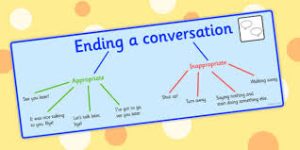
Tips for online conversations
Another aspect of the art of effective communication is knowing when and how to cut a conversation short. It is applicable to every discussion we have, whether it be online or in person. But sometimes it can be a little more difficult to conclude an online conversation.
Try to read the other person’s body language when you are having a video conversation. Look for nonverbal clues that indicate it’s time to conclude the conversation. For instance, you both might be beginning to repeat yourself or they might be seeming bored.
Summary
A vital tool for human connection, socialization, and relationship building, conversations are dynamic, frequently informal exchanges of ideas, emotions, or information between two or more people. In order to establish deep relationships, effective talks frequently incorporate open-ended inquiries, attentive listening, and shared vulnerability.

Conversational tips. Real-time text, phone, or video exchanges over the internet that simulate face-to-face communication are called online conversations. Open-ended inquiries, attentive listening, and the use of multimedia, such as memes, to compensate for the absence of non-verbal cues are all necessary for productive online conversation. Personalizing communications, identifying common ground on social media (like LinkedIn and Twitter), and interacting through video apps are important tactics.
CONVERSATIONAL TIPS
A vital tool for human connection, socialization, and relationship building, conversations are dynamic, frequently informal exchanges of ideas, emotions, or information between two or more people. In order to establish deep relationships, effective talks frequently incorporate open-ended inquiries, attentive listening, and shared vulnerability.
What makes a good conversation?
Many components come together to make a great conversation. These are a few of the factors that help avoid those uncomfortable silences.
1. Active listening

When listening actively, the emphasis is on paying close attention to what the other person is saying. Occasionally, people listen to reply instead of hearing what their conversation partner has to say.
2. Asking and answering questions
Asking follow up questions about other person’s remarks can lead to a longer conversation. Alternatively, you can ask them about anything you’re curious to learn more about or that you didn’t dully comprehend
3. Finding mutual interests and similarities

Listen for experiences that you both share in common during the chat. Having similar interests might help you stay on topic and maintain a smooth flow of discussion.
4. Having an intention for the conversation
It’s usually a good idea to prepare a plan for the conversation, whether you’re at a networking event or you ran into a coworker in the shop.
It’s usually a good idea to prepare a plan for the conversation, whether you’re at a networking event or you ran into a coworker in the shop.
1. Ask lots of questions

Conversational tips
Posing questions demonstrates your curiosity and attentiveness. Just remember to let the other person speak and take the initiative. You don’t want kids to experience questioning.
2. Avoid controversial topics
Always pay attention to the context and the person you are speaking with. Steer clear of subjects that can be interpreted as offensive or contentious. This could be anything from the most recent PTA meeting’s agenda to politics or religion.
3. Make eye contact
Maintaining eye contact with them demonstrates your interest in and participation in the discussion.
You convey to the other person that you are either preoccupied or uninterested in what they are saying if you are constantly gazing around
4. Smile

Conversational tips
It’s very crucial to smile while striking up a discussion.
Before you both speak, give your potential discussion partner a smile. This will demonstrate your friendliness and approachability.
5. Give compliments
A complement is a kind gesture that is always appreciated. Your conversation partner will feel better about themselves if you compliment them. Plus, it will make your conversation richer.
6. Ask for advice or recommendations
Seek guidance or suggestions if you’re unsure of how to maintain a discussion. This demonstrates your active listening skills and your appreciation for their opinions.
7. Maintain a positive attitude;

Conversational tips
We demonstrate our self-control when we conduct a conversation with a pleasant attitude.
Additionally, happy people are more likely to be preferred for chats than negative or frequently complaining individuals.
Summary
Active listening, open-ended inquiries, and succinct messaging are necessary for successful online conversations in order to establish rapport without the use of nonverbal clues. Important tactics include emphasizing engagement over lengthy paragraphs, employing conversational threading to present several subjects, and conveying tone with emojis or GIFs.

Earth Frozen Frontiers

Natural Majestic Wonders

Daily Life Hacks

A Step-by-Step Guide to Deleting Reels on Instagram

A Comprehensive Guide to Setting Up a YouTube Premiere